



Product Introduction
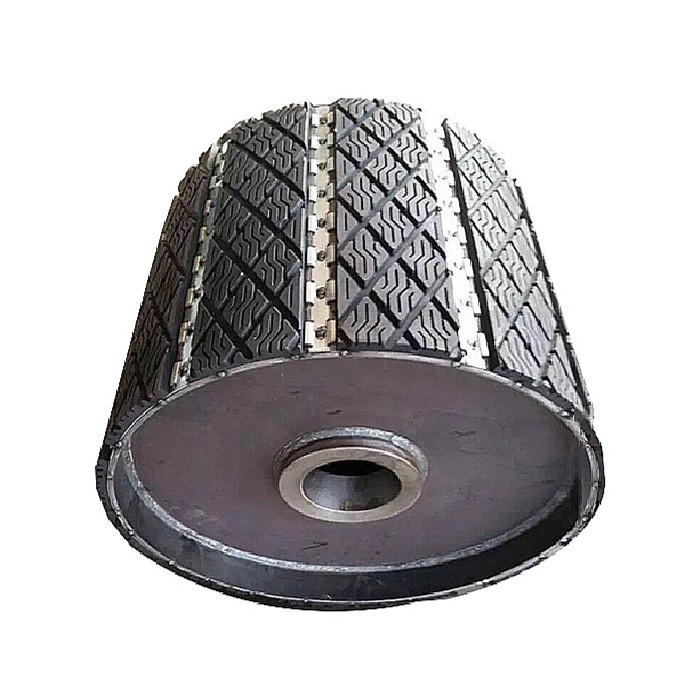
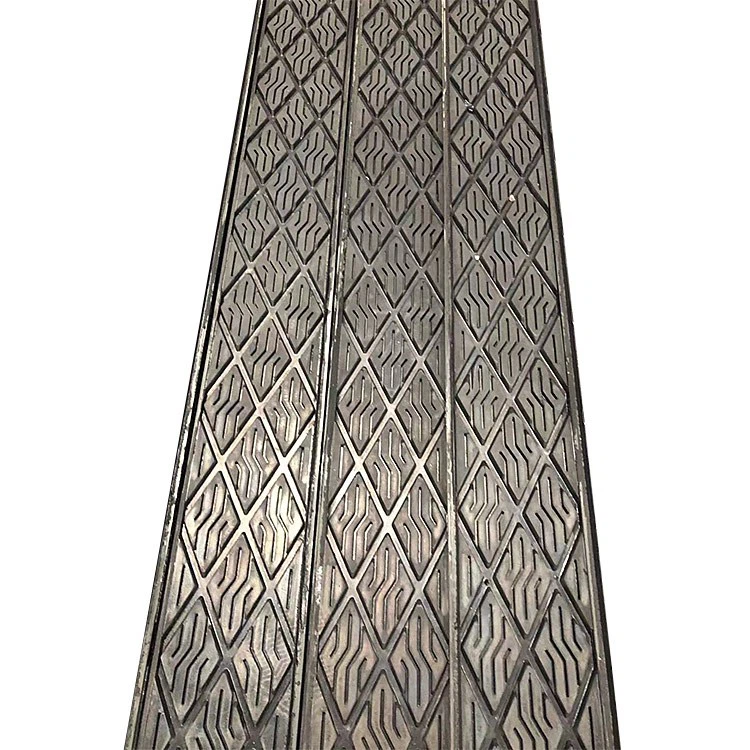
The YIQI Welded Slide Lagging Sheet is an engineered, high‑performance pulley lagging system designed for heavy‑duty conveyor applications where traction, durability, and fast maintenance are critical. Unlike traditional glued rubber lagging, this system uses **rubber bonded to a steel backing plate**, forming modular pads that slide into steel retainer bars welded directly onto the pulley shell. This creates a mechanically locked lagging surface that can withstand high tension, torque surges, and abrasive materials without risk of de-bonding.
With the welded slide‑lag system, the pulley remains installed on the conveyor-only the individual pads are replaced. This dramatically reduces downtime for mines, quarries, cement factories, ports, steel mills, fertilizer plants, and any operation where conveyor shutdown time directly affects productivity.

Key Features
Rubber + steel backing plate provides structural rigidity under high torque
Welded retainers ensure secure mechanical locking
Modular slide‑in pads allow quick replacement without removing pulley
High‑friction rubber surface reduces belt slip
Designed for high‑tension and high‑load drive pulleys
Long wear life in abrasive environments
Custom pad thicknesses, widths, and rubber grades available
Product Specifications

|
Name |
Size |
Width (mm) |
Thickness (mm) |
Length (L) |
||
|
H |
H1 |
H2 |
mm |
|||
|
Lagging Pad |
SRS15 |
B=139 |
15 |
一 |
一 |
1830 |
|
Lagging Pad |
SRS19 |
B=139 |
19 |
一 |
一 |
1830 |
|
Inclined Lagging Pad |
SRE19 |
B=139 |
一 |
13 |
19 |
254 |
|
Double Retainer |
SFK |
一 |
一 |
一 |
1830 |
|
|
Single Retainer |
SFA |
一 |
一 |
一 |
1830 |
|
|
Note: Cut to size available for length (L)upon customer's request. |
||||||
Slide lagging Installation Steps

1. Prepare the Pulley Surface:
Clean the pulley surface thoroughly to ensure that it is free from dirt, grease, and debris. Any surface imperfections should be smoothed out for better adhesion.
2. Mark Installation Points:
Determine the number of lagging pads needed and mark the corresponding installation positions evenly around the pulley surface. Ensure that the layout maintains equal spacing for proper balance and performance.
3. Install the First Retainer:
Position the first retainer along the marked line and weld or bolt it securely onto the pulley surface. Make sure it is aligned parallel to the pulley's axial line for proper pad placement (see Image 1).
4. Insert the Lagging Pad:
Slide one lagging pad into the first installed retainer. Align it carefully. Then, install the second retainer on the opposite side of the pad-again by welding or bolting - so the pad is securely held in place. Repeat this process for each subsequent pad and retainer until all have been installed (see Images 2, 3, 4).
5. Install End Fixtures:
After all pads have been inserted and retainers fixed, install retaining fixtures at both ends of the pad rows. These prevent the pads from sliding out during operation.
6. Single Retainer Positioning:
For single retainers, follow the correct spacing guidelines between each unit as shown in Image 5. Uniform spacing is essential for maintaining stability and performance.
7. Maintenance & Replacement:
To replace lagging pads, first remove the end fixtures. Then, simply slide out the worn pads and insert new ones into the existing retainers. Reinstall the end fixtures to secure the pads in place again (see Image 6).
Suitable Working Conditions
The welded slide lagging system is ideal for:
- • High tension drive pulleys
- • Abrasive mineral materials
- • Moist or muddy environments where adhesive lagging may fail
- • Heavy continuous-duty conveyors
- • Pulleys with frequent slip issues
- • Harsh industrial conditions in mining, steel, cement, power, and ports
- • Sites that cannot afford long shutdowns for re-lagging operations
Because each piece is mechanically anchored, it performs reliably in conditions that typically cause cold-bonded lagging to peel, bubble, or delaminate
Why Choose Welded Slide Lagging?
Compared to conventional cold-bonded or ceramic lagging, welded slide lagging offers significant advantages:
1. Fastest Maintenance
With welded retainers permanently in place, only pads need replacement. No pulley removal, no curing time.
2. Strongest Mechanical Fixing
Welded retainers and steel-backed pads eliminate adhesive failures caused by humidity, oil, or dust.
3. Improved Traction
High-friction rubber increases torque transmission and reduces startup slip.
4. Longer Service Life
Rubber-steel backed pads withstand high tension and material impact better than glued sheets.
5. Lower Long-Term Cost
You replace only worn sections-not the entire pulley covering.
Selection Guide
To choose the right welded slide lagging configuration:
• Pulley diameter and face width
• Required friction coefficient
• Belt tension and drive horsepower
• Material abrasiveness
• Pad thickness and pattern
• Operating environment: dry, wet, muddy, dusty
• Maintenance frequency and replacement strategy
Recommended Rubber Grades:
• Standard rubber for general applications
• High-friction rubber for drive pulleys
• Abrasion-resistant rubber for mineral handling
Benefit
• Reduces conveyor downtime dramatically
• Improves belt grip and prevents slippage
• Protects pulley shell and extends equipment life
• Enhances conveyor startup performance
• Reduces belt wear caused by slip and friction
• Ensures uniform contact and stable torque transmission
• Lower maintenance cost through modular replacement
FAQ
Q1: Can welded slide lagging be used on drive pulleys?
A: Yes-this system is ideal for high tension, high torque drive locations.
Q2: Do I need to remove the pulley to replace pads?
A: No. Only the individual pads slide out; the pulley stays installed.
Q3: Does the steel backing affect pulley balance?
A: Pads are produced with consistent weight for balanced installation.
Q4: How long does it last?
A: Typically longer than glued lagging due to mechanical anchoring.
Q5: Can it operate in wet, muddy, or dusty conditions?
A: Yes. Welded retainers prevent de-bonding even under harsh environments.
Conclusion
The YIQI Slide-lag Lagging Sheet provides a superior pulley lagging solution for demanding conveyor systems.
It combines strong mechanical retention, high-friction performance, and rapid maintenance capability-delivering a long-lasting, cost-efficient alternative to conventional glued lagging.
For detailed drawings, CAD models, or quotations based on your pulley dimensions, contact the YIQI engineering team.
Hot Tags: welded slide lagging sheet, China welded slide lagging sheet manufacturers, suppliers, conveyor slide lagging, plain rubber lagging sheet, pulley slide lagging, replaceable slide rubber pulley lagging, slide lag removable pulley lagging, Slide lagging rubber sheet


