Product Introduction
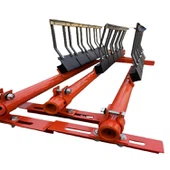
Secondary Polyurethane Belt Scraper – Precision Cleaning for Return Conveyor Belt Systems
The YIQI Secondary PU Belt Cleaner provides the essential second stage of cleaning that most conveyor systems require to control carryback effectively. While primary scrapers remove bulk material at the head pulley, they cannot fully remove fine dust, wet residue, thin films, clay content, or moisture‑affected layers. These contaminants accumulate on return rollers, pulley surfaces, idlers, structural frames, and surrounding walkways, causing unnecessary maintenance, belt misalignment, and housekeeping challenges.
This secondary cleaner is installed on the return side just after the head pulley, where the belt is free from the bulk load ,but still carries a thin residue layer. Its high‑wear polyurethane (PU) blade offers excellent abrasion resistance, belt safety, and long service life. The design ensures uniform blade contact, precise cleaning pressure, and superior fine‑material removal for mining, cement, steel, ports, aggregates, fertilizer processing, and coal handling plants.
Product Features
• High‑wear polyurethane blades engineered for fine residue removal
• Removes moisture film, dust, clay, powder, and sticky fines
• Compatible with 500–2200 mm belt widths (custom sizing available)
• Efficient cleaning at belt speeds up to ~5.0 m/s
• Suitable for mechanical splices and vulcanized belts
• Adjustable tensioning system ensures consistent cleaning force
• Easy and safe slide‑in blade replacement
• Low‑profile frame for tight return‑side installation
• Reduces carryback by up to 90% when used with a primary cleaner
• Minimizes roller fouling, reduces cleaning labor, and improves belt tracking
Technical Specifications
|
Parameter |
Specification |
|
Blade Material |
Polyurethane (PU), flexible and wear-resistant |
|
Blade Type |
Continuous or segmented |
|
Mounting Location |
Return side of belt, after head pulley |
|
Blade Hardness |
Shore A 90 ±5 |
|
Operating Temp Range |
-30°C to 80°C |
|
Belt Speed Compatibility |
Up to 5 m/s (varies by model) |
|
Standard Belt Widths |
500mm–2200mm |
|
Frame Material |
Coated carbon steel or stainless steel |
|
Tensioning Mechanism |
Spring, gravity, or manual adjustable tensioners |
|
Cleaning Efficiency |
Up to 95% when paired with a primary scraper |
Product Categories

**1. Intergrated Blade Secondary PU Scraper**
Equipped with a single, continuous polyurethane blade that spans the full belt width, this model is designed for consistent belt profiles and standard-speed operations. It provides even pressure and effective cleaning for non-cleated belts.
Model: YQ-P
YQ-P Drawing and Parameters

|
Belt Widt (mm) |
500 |
650 |
800 |
1000 |
1200 |
1400 |
1600 |
1800 |
2000 |
2200 |
|
A (mm) |
1500 |
1600 |
1800 |
2000 |
2200 |
2400 |
2600 |
2800 |
3000 |
3200 |
|
B (mm) |
500 |
600 |
800 |
1000 |
1200 |
1400 |
1600 |
1800 |
2000 |
2200 |

**2. Segmented Blade Secondary PU Scraper**
This variation features individually mounted scraper segments that conform to uneven surfaces or belts with worn sections. Segmented blade primary designs are popular for improving coverage and reducing gaps in cleaning performance across varying belt conditions.
Model: YQ-JP
YQ-JP Drawing and Parameters
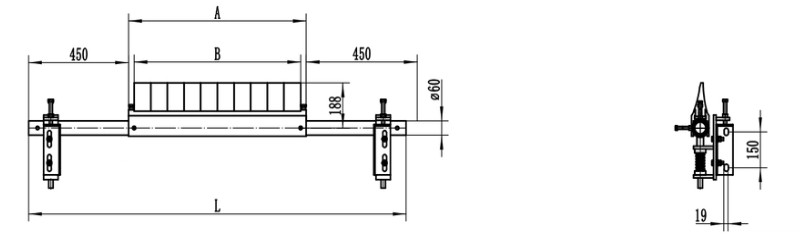
| Model | Belt Width | B(Blade width) | A(Base length) | L(steel tube length) |
| YQ-JP | 500 | 450 | 500 | 1400 |
| 650 | 600 | 650 | 1550 | |
| 800 | 750 | 800 | 1700 | |
| 1000 | 900 | 1050 | 1950 | |
| 1200 | 1050 | 1100 | 2000 | |
| 1400 | 1350 | 1400 | 2300 | |
| 1600 | 1500 | 1550 | 2450 | |
| 1800 | 1650 | 1700 | 2600 | |
| 2000 | 1950 | 2000 | 2900 | |
| 2200 | 2100 | 2150 | 3050 |
Application Areas
The YIQI Secondary PU Belt Cleaner excels in the following applications:
- Mining & Aggregates
Fine ore dust, clay‑mixed materials, crusher fines, mineral residue that adheres to belt surfaces.
- Cement & Lime
Clinker powder, limestone dust, fly ash, gypsum residue-especially where humidity varies.
- Steel Plants & Power Stations
Coal dust, wet fines, slag residue that must be removed before the belt returns.
- Fertilizer & Chemical Processing
Urea, phosphates, potash, chemical granules with sticky or moisture‑rich surfaces.
- Ports & Bulk Terminals
Dust‑rich loading and unloading conveyors requiring higher cleanliness.
- Food/Grain
Powdered grain, flour, sugar, or food‑grade residue requiring gentle belt contact.
Selection Guide
To choose the correct model, consider:
- Belt width and belt splice design
- Material characteristics – abrasiveness, dust content, moisture level
- Belt speed and conveyor loading
- Available installation space
- Required cleaning efficiency and maintenance intervals
- Environmental temperature and humidity
Blade Selection Recommendations:
- Standard PU – typical powders and dry fines
- Soft PU – wet, clay‑sticky, moisture‑rich materials
- Abrasion‑resistant PU – silica, sand, mineral dust, high‑abrasion materials
Benefits & System‑Level Advantages
- Extends belt life by reducing abrasive contact
- Improves belt tracking by preventing residue buildup
- Reduces dust emissions at transfer points
- Enables smoother operation of return rollers
- Minimizes manual cleaning labor and shutdown maintenance
- Boosts overall conveyor system efficiency
- Supports environmental and safety compliance
- Reduces housekeeping costs in dust‑sensitive environments
Frequently Asked Questions (FAQ)
Q1: Is the secondary cleaner a replacement for a primary cleaner?
A: No. It complements the primary cleaner by removing fine residue and films that the primary blade cannot reach.
Q2: Will the PU blade damage my conveyor belt?
A: No. Polyurethane blades are flexible and belt‑friendly, even with mechanical splices.
Q3: How long does a PU blade typically last?
A: Typically 6–12 months depending on material, belt speed, and abrasiveness.
Q4: Can the cleaner be installed in compact spaces?
A: Yes, its low‑profile structure works well in restricted return‑side conditions.
Q5: Can this cleaner handle wet and sticky materials?
A: Yes. PU is excellent for removing moisture, clay, and sticky fines.
Related Products
• Ceramic Primary Belt Cleaner
• Motorized Brush Belt Cleaner
Hot Tags: secondary pu belt cleaner, China secondary pu belt cleaner manufacturers, suppliers, Polyurethane PU Blade Secondary Belt Cleaner, Secondary Belt Cleaner with Tungsten Carbide Tip, Secondary PU Belt Cleaner, Secondary Reversing Belt Cleaner